
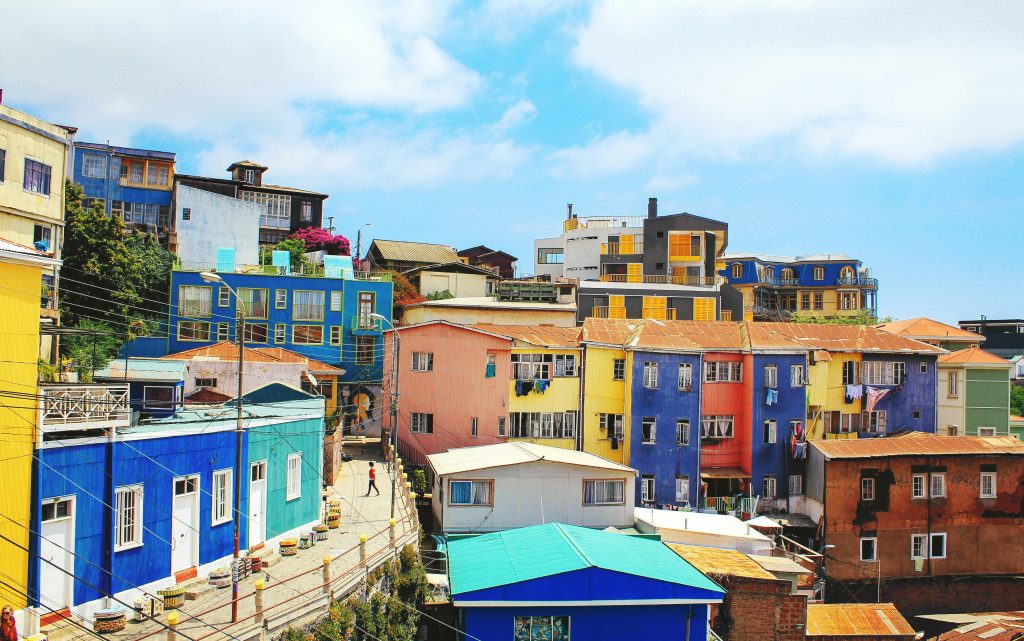
Internship in Valparaíso, Chile
Johannes
Electrical Engineering and Information Technology, HTWK Leipzig
My Experience Searching for an Internship Placement and Applying
I first became aware of the PUCV through the DAAD-RISE program. Although my application through that program didn’t work out for this particular project, contact with the professor at the PUCV had already been established. So I coordinated the internship placement directly with him and received confirmation without any difficulties. The real hurdle was funding: a DAAD scholarship (outside of RISE) had been rejected, so I ultimately received funding for the internship through Erasmus+ with Leonardo-Sachsen. It was a graduate internship completed after my Bachelor’s degree.
I needed the usual documents (CV, motivation letter, Learning Agreement); I did not need a language certificate, since my supervisor speaks German. Coordinating with HTWK Leipzig and Leonardo-Sachsen was uncomplicated, and my emails were always answered promptly. It was important to clarify in advance with both parties whether my internship was eligible for funding. Like many others, I found the Mobility Online portal not particularly user-friendly, but that is a nationwide issue in Germany.
My Experience Searching for Accommodation and Traveling There
The apartment search in Valparaíso works significantly better on-site than from a distance. I was lucky and found a host family who welcomed me very warmly. I can especially recommend this, also as a way to learn the language. I paid €250 per month, which is slightly below average (more likely around €300).
I traveled by plane via Barcelona to Santiago de Chile and continued from there by Flixbus. Overall, this was somewhat more expensive than the Erasmus+ travel allowance provided for, because fuel prices were high.My tip: In Chile, there is a large network of Germans, for example through Facebook groups. There you can quickly find help and orientation, and you are less likely to fall victim to scams.

My advise for you:
It's best to look for your accommodation on-site, and if possible, move in with a host family – it helps enormously with learning the language.
My Experience During the Internship
I was at the research laboratory LabSens in the School of Electrical Engineering at PUCV, which develops sensors and measuring instruments for applied research, particularly on light pollution and night sky brightness. There, I took on the optical characterization of a SiPM-based measuring instrument for night sky brightness. For this, I built an automated ray-tracing simulation using Ansys Zemax and Python, evaluated the results radiometrically, and investigated the influence of manufacturing tolerances.
I mostly worked independently on my laptop, supplemented by occasional assignments in the laboratory. I had a great deal of freedom in how I implemented things, and was still given guidance whenever I needed it. Communication was in German. Together with my supervisor, I also wrote an initial draft for a scientific paper.
One difficulty was that hardly anyone on the team was familiar with Zemax. Instead of explaining it to everyone individually, I built an interface through which the simulations could be launched and evaluated even without prior knowledge. The code is documented and published as an open-source repository, so that the laboratory can continue working with it. In terms of professional skills, I deepened my programming knowledge and optical simulation skills; personally, I learned to work with considerably more independence and responsibility.
My Experience with Everyday Life and Leisure Time On-Site
I took the micro (bus) to the university, about 15 minutes directly along the coast, for around 600 Chilean pesos (roughly 60 cents) per ride. Eating out was similarly priced to Germany, while grocery shopping at the supermarket was somewhat more expensive. Life in general is simpler than here: for example, many houses have no heating, and people seem content with what they have.
My host family was wonderful – the members became close friends to me. I gradually improved my Spanish, even though the Chilean dialect is a real challenge at first. In my free time, I went bouldering a lot (there are several bouldering gyms), occasionally went surfing, took day trips to the Andes for hiking, and visited Santiago on weekends. I made contacts with local students and other exchange students primarily outside the university, while bouldering.
Chile is a very political and exciting country with an interesting history of immigration, and the nature is impressive. When it comes to safety, you should stay alert: people often talk about dangerous places, and acquaintances of mine were robbed. Nothing happened to me personally, and overall, I thoroughly enjoyed my time there.
My Conclusion & Tips
For me, it was my first stay in Latin America and at the same time a completely new working environment, and both were very much worth it. Professionally, I was able to push my own project forward substantially; personally, I learned Spanish, formed close friendships, and got to know a country that impressed me deeply. Later on, I also visited the Atacama Desert, where the instruments the laboratory works on are deployed.
The high costs were less pleasant: flights, food, and supermarket purchases were significantly more expensive than expected. In addition, you have to stay alert in Chile when it comes to safety, and the Chilean dialect is a challenge at first.
My tips: It’s best to look for your accommodation on-site, and if possible, move in with a host family – it helps enormously with learning the language. Use the German network in Chile (e.g., Facebook groups) for help and orientation. And above all: enjoy your time and don’t spend it all on work. I would do it again in a heartbeat, though next time with a bit more time for leisure.
Spread the word!
Would you like to see your photos and experiences here to share with others?
Then fill in the document “My experiences”, sign the data privacy document and send them via email to auslandspraktikum@tu-dresden.de.